Leading industries and organizations have been embracing digital transformation to guide their business strategies for many years. Businesses, that were slow to adapt, or had not even started were forced to rise to the occasion with the onset of the Covid-19 pandemic. Quick adaptation to the new normal required to adjust to remote work, online learning, and education and triggered even greater demand for sophisticated digital consumer experiences.
Since everything “digital” usually ends up in the care of the IT department, investment in powerful tools, processes, and practices is essential to help software and app development teams create high-quality digital products. Only so, they can close digital gaps, get up to speed and prepare for the future.
One of these powerful tools to assist development teams is KUBERNETES, an open-source container orchestration system originally developed by Google. As the flagship project of the Cloud Native Computing Foundation (CNCF), it has the support of top players such as Google, Microsoft, Amazon Web Services, Intel, IBM, Cisco, and of course Red Hat.
In this short post, we discuss how businesses and organizations can benefit from using Kubernetes. We provide reasons, why investing in it helps not only staying competitive but supports your digital-first business approach. Our insights will help the C-suite discover the scope of automation orchestration challenges and explains, why technologies like Kubernetes should be on their radar. But first things first.
What Kubernetes is for
</>Most legacy organizations (government, financial services, education, etc.) are dealing with monolithic technology stacks that require continuous maintenance and scaling (often still performed semi-manually) and may cause delayed delivery of software updates or new applications. Breaking down these bloated monoliths is achieved by re-designing entire IT architectures to container microservices. Containerization has significantly changed the way software developers and operations teams develop, scale and deploy applications today. On the one hand, containers facilitate and speed up processes; on the other hand, their use requires constant, multifaceted adjustments to the IT environment. This is where automated container management and flawless container orchestration prove indispensable. One support solution, that is widely accepted standard, is Kubernetes.
How Kubernetes orchestration works
</>As a set of building blocks, Kubernetes provides mechanisms to deploy, maintain, and scale applications. One of the most basic duties it assists your IT teams in, is keeping an application up, running, and responsive to the ever-changing user demands.
Overall it manages:
- the health and lifespan of applications
- replication
- load balancing and
- hardware resource allocation.
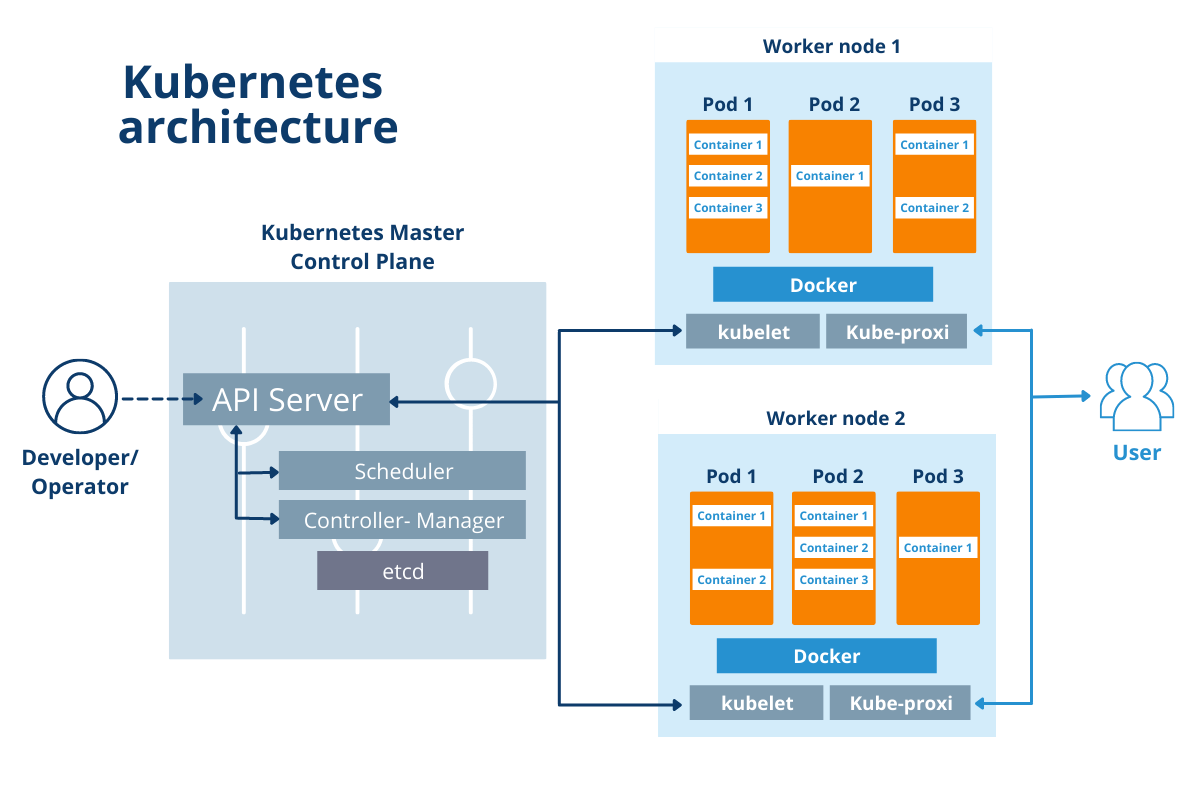
The central component of Kubernetes is the so-called cluster. A cluster is made up of a master (the brain of the operation) and worker nodes, that host one or several containers. The master, communicating with the nodes, handles container scheduling and instructs when to create or destroy containers and how to re-route traffic based on newly arranged container placements.
Operators access Kubernetes clusters via the master node through a Command Line Interface (CLI) tool, a Web User-Interface (Web UI) Dashboard, or Application Programming Interface (API).
The following illustration depicts a simplified Kubernetes cluster.
More details on Kubernetes components and architecture here.
In addition to Docker, Kubernetes can also work with any container system, as long as the container image and runtime formats conform to the Open Container Initiative (OCI).
Kubernetes is truly open, as it allows developers to choose different programming languages and a variety of cloud platforms (AWS, Google Cloud, Microsoft Azure, etc.) to build, scale and deploy their applications. It orchestrates all sorts of containerized solutions.
What it can’t do, it does not manage source code and does not build ready-to-use applications as Platform-as-a-Service (PaaS) solutions, which might jump to mind.
Common misconceptions
</>With Kubernetes being relatively new in the field of software delivery, and its jargon-heavy technical minutiae, it is no wonder some misconceptions about its efficacy exist, especially among C-level executives.
Here are common misunderstandings, debunked:
There is only Kubernetes
Several simple, cost-effective alternatives to Kubernetes exist, including Docker Swarm, Amazon ECS, Apache Mesos, as well as combinations. Although Kubernetes is not required to run production software, depending on your individual and team needs, it could be beneficial. So always investigate before making a decision.
Kubernetes solves all problems
Many organizations believe that Kubernetes is the perfect solution to fix their problems, entrenched in legacy or faulty code, bad app design, or unfortunate development framework choices. Because Kubernetes is popular, it’s often pushed into settings that won’t exactly profit from it.
Kubernetes is per se secure
Kubernetes offers a great deal of versatility and resilience, however, one must not assume that anything is inherently secure. Almost every day, new vulnerabilities are introduced into systems. Kubernetes should be carefully designed to include IT security features, which are constantly surveyed and adapted.
Transitioning to Kubernetes
</>Although Kubernetes might seem complex from the outside, it gives expert users full flexibility.
It allows organizing containers into pods that can be scaled automatically which helps to ramp resources up and down to adjust to demand. There is no “right” or “wrong” way of operating Kubernetes. With the right skill set and a carefully designed IT architecture – systems created with Kubernetes are extremely secure, robust, and reliable.
Although it may seem difficult to implement Kubernetes in an already crowded software pipeline, it is well worth the effort. Rackspace says Kubernetes can help manage containers at a scale much more “feasibly and less resource-intensively,” which can result in lower costs, increased cloud flexibility, and more efficient workplaces.
Some industries might be reluctant to introduce new technologies and the latest trends in software delivery. However, rest assured, that migration to Kubernetes can be smooth when supported by an experienced team, such as newbIT.
How to get started with Kubernetes
</>Ensure that you check the following points, before diving into Kubernetes:
- Perform an IT infrastructure audit and analyze whether containerizing applications make sense
- Check, if there are financial constraints and/or a lack of internal IT skills, which are usually to blame when enterprise applications are not migrated to microservices
- Assign an IT project team to lead and fine-tune the migration process
- Provide full support and resources – make it a boss thing
Where to get talent
</>With more companies moving toward a digital-first business approach, demand for digital skills is on the rise. And this is reflected in a thriving tech jobs market. ZDNet reports, that software developer skills were one of the top IT skills CTI’s were looking for in 2019 and even more in 2021. Nearly 900,000 ads for new tech roles were posted in Q1 2021 alone, according to CompTIA’s June 2021 European Tech Hiring Trends report. This represents a 40% increase over the third quarter of 2021.
To complete the migration process and upskill IT teams, also consider hiring DevOps engineers early or start working with external Kubernetes consultants. They will become increasingly in demand as companies progress with digital transformation projects. They are needed to keep your enterprise IT systems secure, updated, and fit for the future. So don’t try to save at the wrong spot.
The Kubernetes system may seem hard to grasp technically, but it has become a successful solution for building not only high-quality digital products but supporting a digital-first approach.
Kubernetes has the potential to become your key success driver – and a technology that the C-suite shouldn’t ignore. Especially as organizations strive for long-term growth and sustainability following a period of rapid transformation.
Fragen?
Wir helfen gern, unverbindlich, kompetent und fast automatisch.